The ensemble Kalman filter (EnKF) and its many variants have been proven effective for data assimilation in large models, including those in atmospheric, oceanic, hydrologic, and petroleum reservoir systems. By bringing together technical experts, practitioners, researchers and students for presentations and informal interchange of information, we aim to share research results and suggest important challenges that have yet to be addressed.
Program
Venue: 30 May - 02 June, Kviknes Hotel, Balestrand, Norway
Schedule Itinerary and tickets
Abstract submission
- One page by email to Xiaodong Luo
- There is no paper submission
To facilitate the workshop organization, we encourage our participants to submit abstracts with full information of all authors (e.g., name, affiliation, etc.). About one page must be e-mailed to Xiaodong Luo.
Caution
The abstract submission process has now closed (February 15, 2022)
Scientific committee
- NORCE Energy & Technology
- Xiaodong Luo, Geir Evensen, Dean Oliver
- NERSC
- Laurent Bertino
- Equinor
- Remus Hanea
Invited speakers
|
Berent Å. S. Lunde
Equinor, Norway |
Graphical sparse precision matrix estimation and the ensemble information filter |
|
Femke Vossepoel
TU Delft, Netherlands |
On state and parameter estimation in earthquake cycle models |
|
Matthew Levine
Caltech, USA |
A Framework for Machine Learning of Model Error in Dynamical Systems |
|
Yue (Michael) Ying
NERSC, Norway |
Multiscale alignment ensemble filtering technique and its application in geoscience |
|
Yuqing Chang
NORCE, Norway |
Application of Ensemble-Based Methods in Reservoir Management Decision Support |
Presentations
| Håkon Gryvill et al. | talk | Block updating in a band matrix formulation of Bayesian EnKF |
| Sebastian Ertel et al. | talk | An ensemble Kalman-Bucy filter for correlated observation noise |
| Yue (Michael) Ying | talk | Multiscale alignment ensemble filtering technique and its application in geoscience |
| Joffrey Dumont Le Brazidec et al. | talk | Integrating measurement representativeness and release temporal variability to improve the Fukushima-Daiichi 137Cs source reconstruction |
| Clemens Cremer et al. | talk | Combining machine learning and data assimilation to improve the hydrodynamic forecasting in a tidal estuary |
| Yiguo Wang et al. | talk | Benefit of vertical localisation in sea surface temperature assimilation: identical twin experiments |
| S. Spada et al. | talk | A Gaussian high-order sampling hybrid filter for biogeochemical data assimilation: application to chlorophyll satellite data |
| Vikram Khade | talk | Using Deep Learning to increase the ensemble size in an EnKF with the recentering technique: experiments with Lorenz 1996 model |
| C.G. Krishnanunni et al. | talk | A new look at the ensemble Kalman Filter: Duality and non-asymptotic analysis |
| Ian Grooms | talk | How does the regression step in the two-step EnKF connect to Bayesian estimation? |
| F. Silva et al. | talk | A reduced basis ensemble Kalman method for inverse problems |
| Toni Viskari | talk | Estimating soil organic carbon stocks with ensemble Kalman Filter methods |
| Bart de Leeuw et al. | talk | A shadowing-type data assimilation method for partially observed models |
| Nazanin Abedini et al. | talk | Convergence properties for a data-assimilation method based on a Gauss-Newton iteration |
| Yuqing Chang | talk | Application of ensemble-based methods in reservoir management decision support |
| Tarek Diaa-Eldeen et al. | talk | Observability-based ensemble initiation for the EnKF in history matching problems |
| Marc Bocquet et al. | talk | Online algorithms for learning data-driven models of chaotic dynamics |
| N. Lafon et al. | talk | Learning variational DA models and solvers with uncertainty quantification |
| Xin-Lei Zhang et al. | talk | Learning neural network-based turbulence models with ensemble Kalman method |
| Sungil Kim et al. | talk | Recurrent application of pseudo ensemble smoother for calibration of channelized reservoirs using convolutional autoencoder |
| Paulo Henrique Ranazzi et al. | talk | Deep convolutional generative adversarial network as parameterization method in data assimilation of non-Gaussian fields |
| Guannan Hu et al. | talk | Sampling error in the estimation of observation error covariance matrices using observation-minus-background and observation-minus-analysis statistics |
| Ziming Liu et al. | talk | A sampling method based on the second order Langevin dynamics |
| Berent Anund Stromnes Lunde et al. | talk | Graphical sparse precision matrix estimation and the ensemble information filter |
| Mohammad Nezhadali et al. | talk | Towards application of multilevel data assimilation in realistic reservoir history-matching problems |
| Dean Oliver | talk | Data assimilation in hierarchical models |
| Koji Yamamoto et al. | talk | Gas production from methane hydrates and application of data assimilation technique |
| Mina Spremic et al. | talk | Bayesian seismic rock physics inversion using a localized ensemble-based approach - with an application to the Alvheim field |
| Florian Beiser et al. | talk | Handling sparse observations in ensemble-based filtering with an application to drift trajectory forecasting |
| Xiaodong Luo et al. | talk | Continuous Hyper-parameter OPtimization (CHOP) in an ensemble Kalman filter |
| Patrick N. Raanes | talk | Possible improvements to EnOpt for control |
| Lilian Garcia-Oliva et al. | talk | Atmospheric constrain in NorCPM |
| Yue (Michael) Ying | talk | Multiscale alignment ensemble filtering technique and its application in geoscience |
| Joffrey Dumont Le Brazidec et al. | talk | Integrating measurement representativeness and release temporal variability to improve the Fukushima-Daiichi 137Cs source reconstruction |
| Clemens Cremer et al. | talk | Combining machine learning and data assimilation to improve the hydrodynamic forecasting in a tidal estuary |
| Yiguo Wang et al. | talk | Benefit of vertical localisation in sea surface temperature assimilation: identical twin experiments |
| S. Spada et al. | talk | A Gaussian high-order sampling hybrid filter for biogeochemical data assimilation: application to chlorophyll satellite data |
| Vikram Khade | talk | Using Deep Learning to increase the ensemble size in an EnKF with the recentering technique: experiments with Lorenz 1996 model |
| C.G. Krishnanunni et al. | talk | A new look at the ensemble Kalman Filter: Duality and non-asymptotic analysis |
| Ian Grooms | talk | How does the regression step in the two-step EnKF connect to Bayesian estimation? |
| F. Silva et al. | talk | A reduced basis ensemble Kalman method for inverse problems |
| Toni Viskari | talk | Estimating soil organic carbon stocks with ensemble Kalman Filter methods |
| Bart de Leeuw et al. | talk | A shadowing-type data assimilation method for partially observed models |
| Nazanin Abedini et al. | talk | Convergence properties for a data-assimilation method based on a Gauss-Newton iteration |
| Yuqing Chang | talk | Application of ensemble-based methods in reservoir management decision support |
| Tarek Diaa-Eldeen et al. | talk | Observability-based ensemble initiation for the EnKF in history matching problems |
| Marc Bocquet et al. | talk | Online algorithms for learning data-driven models of chaotic dynamics |
| N. Lafon et al. | talk | Learning variational DA models and solvers with uncertainty quantification |
| Xin-Lei Zhang et al. | talk | Learning neural network-based turbulence models with ensemble Kalman method |
| Sungil Kim et al. | talk | Recurrent application of pseudo ensemble smoother for calibration of channelized reservoirs using convolutional autoencoder |
| Paulo Henrique Ranazzi et al. | talk | Deep convolutional generative adversarial network as parameterization method in data assimilation of non-Gaussian fields |
| Guannan Hu et al. | talk | Sampling error in the estimation of observation error covariance matrices using observation-minus-background and observation-minus-analysis statistics |
| Ziming Liu et al. | talk | A sampling method based on the second order Langevin dynamics |
| Berent Anund Stromnes Lunde et al. | talk | Graphical sparse precision matrix estimation and the ensemble information filter |
| Mohammad Nezhadali et al. | talk | Towards application of multilevel data assimilation in realistic reservoir history-matching problems |
| Dean Oliver | talk | Data assimilation in hierarchical models |
| Koji Yamamoto et al. | talk | Gas production from methane hydrates and application of data assimilation technique |
| Mina Spremic et al. | talk | Bayesian seismic rock physics inversion using a localized ensemble-based approach - with an application to the Alvheim field |
| Florian Beiser et al. | talk | Handling sparse observations in ensemble-based filtering with an application to drift trajectory forecasting |
| Xiaodong Luo et al. | talk | Continuous Hyper-parameter OPtimization (CHOP) in an ensemble Kalman filter |
| Patrick N. Raanes | talk | Possible improvements to EnOpt for control |
| Lilian Garcia-Oliva et al. | talk | Atmospheric constrain in NorCPM |
Tip
Additional presentations may be available by contacting the presenters.
Photos
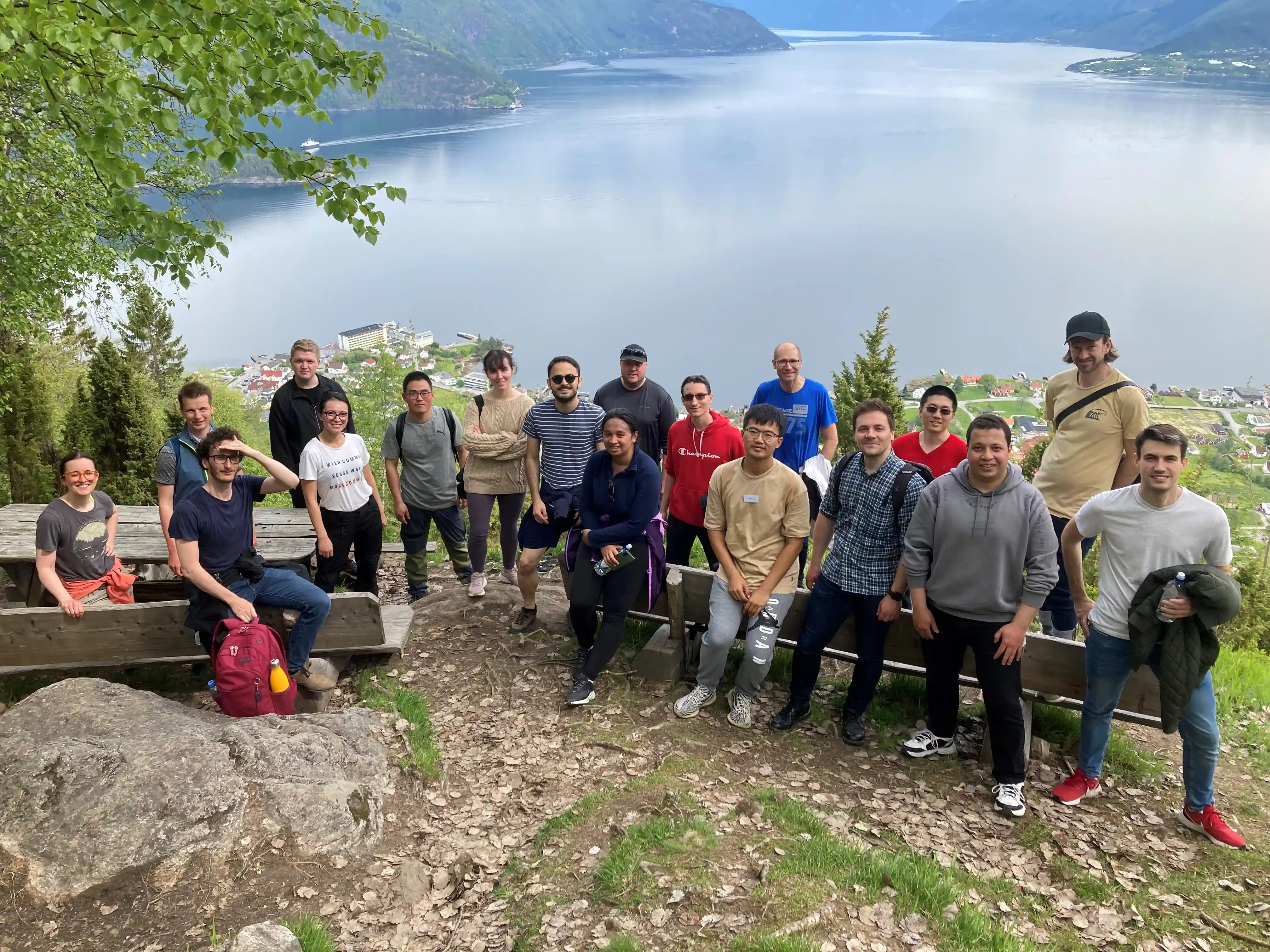
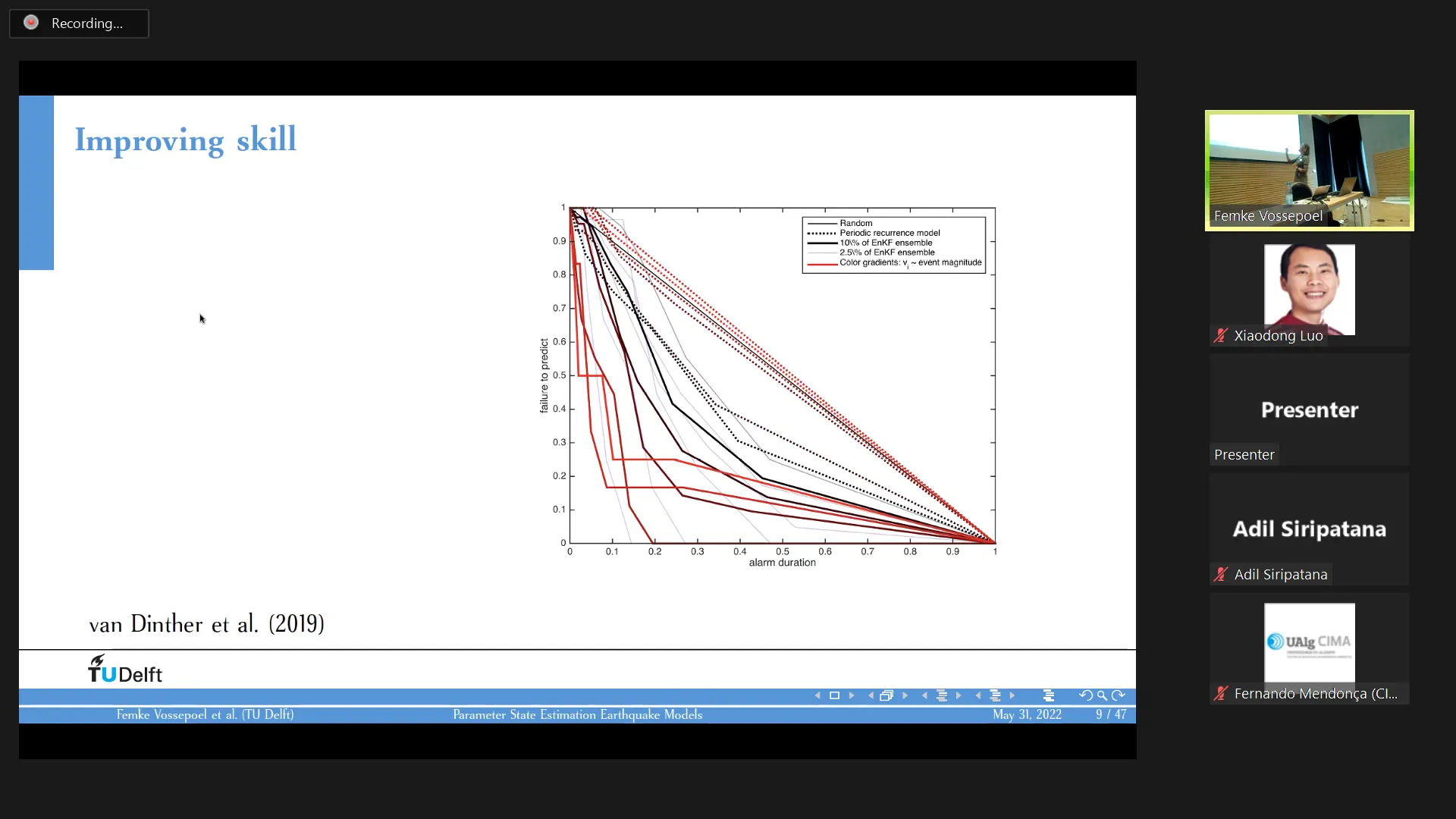
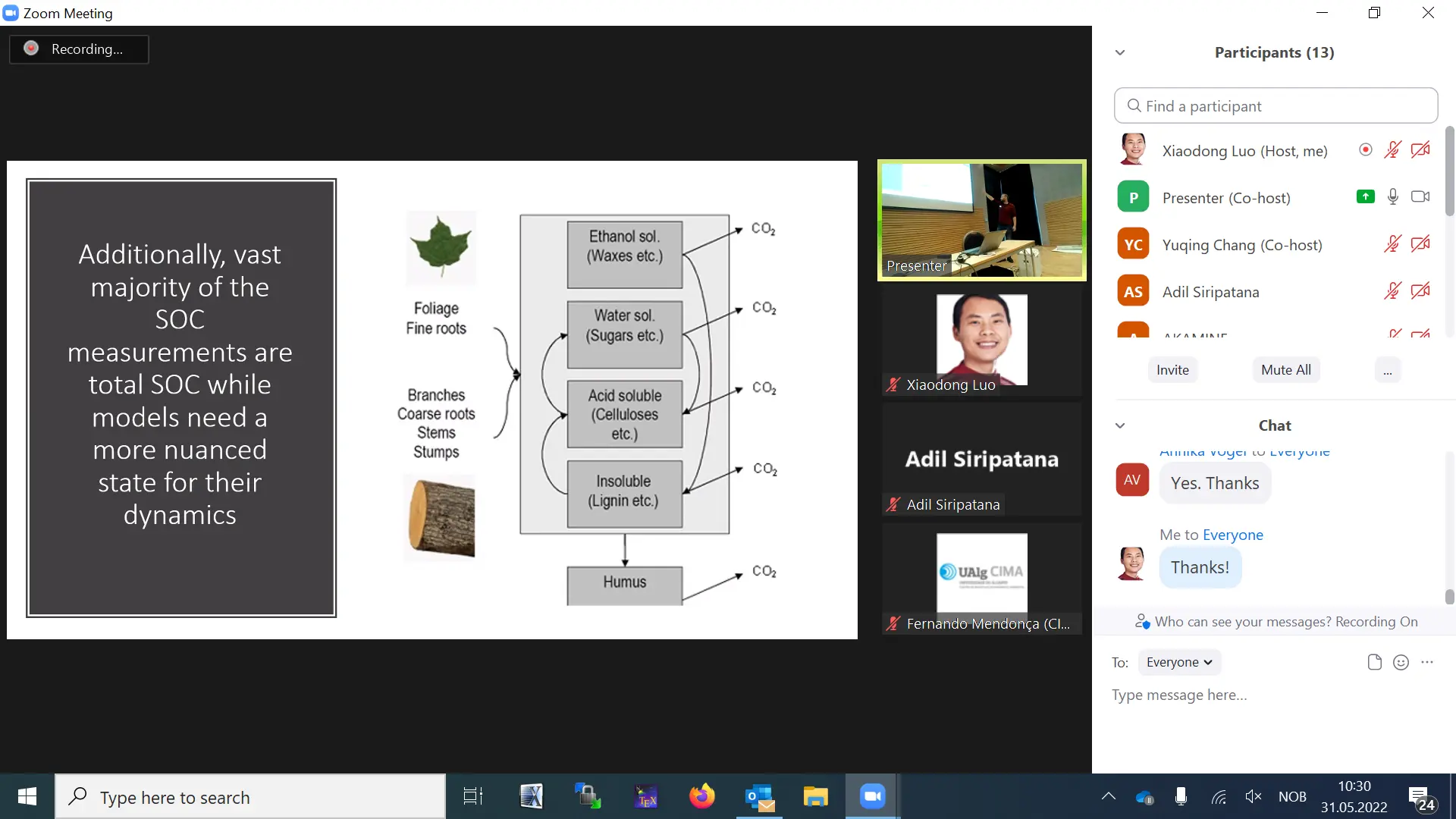
Background
The EnKF is a data assimilation method invented and continuously developed by researchers at the Norwegian Research Centre (NORCE). In the past two decades, the EnKF and related “ensemble” methods have been established as a school of viable and popular methods for data assimilation in very large models, and have made immense impacts on the advancements of various disciplines and promoted value creations for relevant industries.
Sponsors:


Please contact Randi Valestrand if you want to sponsor the workshop.
Purpose
Although the basic concept ensemble methods is straightforward, successful practical implementations often require modifications that are problem-specific. By bringing together experts from diverse areas, we aim to explore the bases and connections among EnKF-related methods that are proven to work in different environments, so that the resulting applications are more robust and efficient. Other than the aspect of practical applications, this workshop also aims to exchange and communicate novel research ideas, methods, algorithms and/or workflows that have the potential of further improving the performance of EnKF and its related methods.
History
The first EnKF workshop took place in Voss (Norway) in 2006. Since then, the EnKF workshop has been held annually (except for a disruption in 2020 due to COVID-19). The EnKF workshop has always accommodated participants coming from diverse scientific disciplines (e.g., meteorology, oceanography, hydrology, to name a few). The communication and exchange of scientific progresses and advancements have led to even more fruitful discussions and raised the scientific quality of the workshop to a very high level. As such, the annual international EnKF workshop has now become one of the most influential events within the data assimilation community.


